
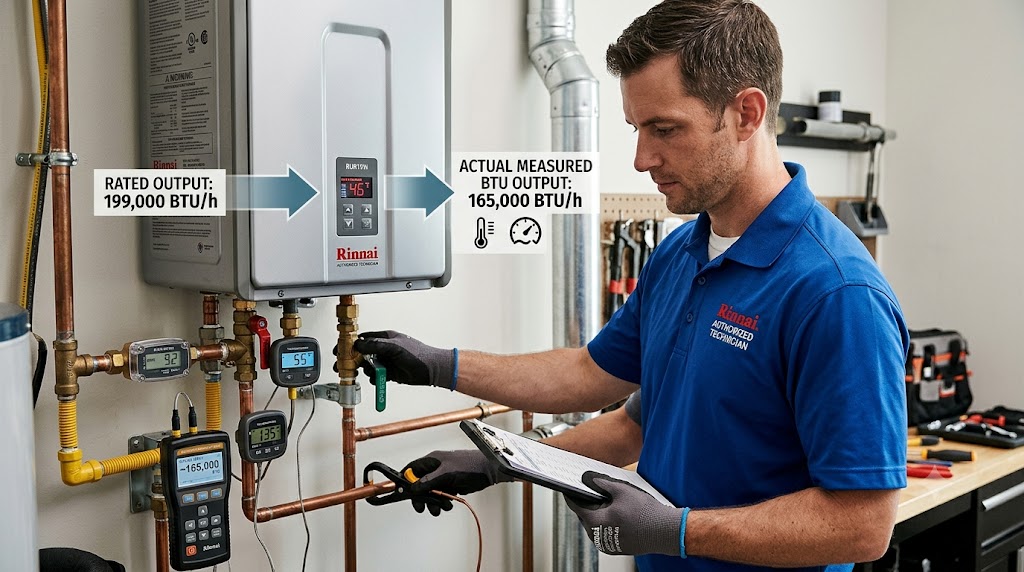
A homeowner researching the RXP199iN sees “199,000 BTU” on the spec sheet and assumes that number tells the whole story of how much hot water they’ll actually get. The reality is more nuanced, and understanding the difference between rated BTU input and real-world output can prevent a sizing mismatch in your home.
The 199,000 BTU figure on Rinnai’s RXP199iN and RX199iN refers to the unit’s maximum gas input rating, not a direct one-to-one measure of hot water output, and actual usable performance is better measured through the unit’s GPM (gallons per minute) flow rate at your home’s specific incoming water temperature. This distinction matters more than the BTU number alone when sizing a unit for your household.
What BTU Rating Actually Measures
BTU (British Thermal Unit) input rating measures how much heat energy the unit’s burner can produce at maximum output. It’s a measure of gas-burning capacity, not a direct measure of gallons of hot water delivered, since actual water heating output depends on how efficiently that heat transfers to the water and how much temperature rise is required.
Why GPM at Temperature Rise Is the More Useful Number
Rinnai and other manufacturers publish flow rate specifications at specific temperature rise figures, for example, GPM at a 67°F rise. This number tells you how many gallons per minute of hot water the unit can actually deliver at a given temperature increase from incoming water temperature to your target hot water temperature.
This is the number that actually determines whether a unit can handle running your shower and dishwasher simultaneously, not the raw BTU rating alone.
How Incoming Water Temperature Affects Real-World Output
A unit’s real-world performance varies by season and location, since incoming groundwater temperature changes with climate and time of year. A home in a colder climate needs a larger temperature rise to reach the same output hot water temperature, which reduces the unit’s maximum flow rate compared to a home with warmer incoming groundwater.
This is why the same 199,000 BTU unit can feel like it performs differently between summer and winter, or between a home in Minnesota and a home in Florida.
Rated Input vs Actual Efficiency
Not all of the rated BTU input converts directly into usable heat for your water, since combustion and heat transfer processes have real-world efficiency losses. Rinnai’s condensing technology, which extracts additional heat from exhaust gases before they leave the unit, improves on this efficiency compared to older non-condensing designs, which is reflected in the unit’s Energy Factor or UEF rating rather than the raw BTU number.
What This Means for Sizing Your Unit
When sizing a tankless water heater for your home, use the manufacturer’s GPM-at-temperature-rise chart specific to your climate’s typical incoming water temperature, rather than relying on the BTU rating alone to judge whether a unit will meet your household’s hot water demand. See our [sizing guide] for the full methodology.
Rinnai RXP199iN Condensing Tankless Water Heater with Built-In Recirculation Pump - View on Amazon
The Bottom Line
The 199,000 BTU figure on Rinnai’s units measures maximum gas input, not a direct measure of hot water output. Use the manufacturer’s GPM-at-temperature-rise specifications, adjusted for your climate’s incoming water temperature, to accurately judge real-world performance for your household.
Frequently Asked Questions
Does a higher BTU rating always mean more hot water? Not directly, BTU rating measures gas input capacity, while actual hot water output depends on temperature rise requirements and the unit’s efficiency at converting that heat.
What’s a better number to look at than BTU for sizing? GPM (gallons per minute) flow rate at a specific temperature rise is a more useful real-world performance measure than the raw BTU rating alone.
Why does my tankless water heater perform differently in winter? Colder incoming groundwater temperature requires a larger temperature rise to reach your target hot water temperature, which reduces maximum flow rate compared to warmer months.
Does climate affect how a tankless water heater performs? Yes, homes in colder climates need a larger temperature rise and will see somewhat reduced maximum flow rate compared to homes in warmer climates, for the same rated unit.
What does UEF or Energy Factor measure? This measures the unit’s overall efficiency at converting fuel input into usable hot water output, a more complete efficiency picture than BTU rating alone.
Is the RXP199iN’s 199,000 BTU rating the same as its water output in gallons? No, BTU measures maximum gas input capacity, water output in gallons per minute depends on temperature rise and is shown separately in the unit’s flow rate specifications.
Why do condensing units have better efficiency than non-condensing units at the same BTU rating? Condensing technology extracts additional heat from exhaust gases before they leave the unit, improving overall efficiency beyond what the raw BTU input figure suggests.
How do I know if a 199,000 BTU unit is right for my home? Check the manufacturer’s GPM-at-temperature-rise chart against your home’s typical incoming water temperature and expected simultaneous hot water demand.
Does the BTU rating affect installation requirements like gas line size? Yes, higher BTU ratings generally require larger gas lines to deliver adequate gas volume, this is separate from the water output consideration but equally important.
Should I compare units by BTU rating alone when shopping? No, compare GPM at your climate’s relevant temperature rise and overall efficiency ratings, rather than relying on BTU rating as the primary comparison point.
References
- Rinnai official product specifications for the RXP199iN, including BTU and GPM ratings, accessed July 2026: https://www.amazon.com/s?k=Rinnai+RXP199iN
- Rinnai official technical documentation, accessed July 2026: https://www.rinnai.us