
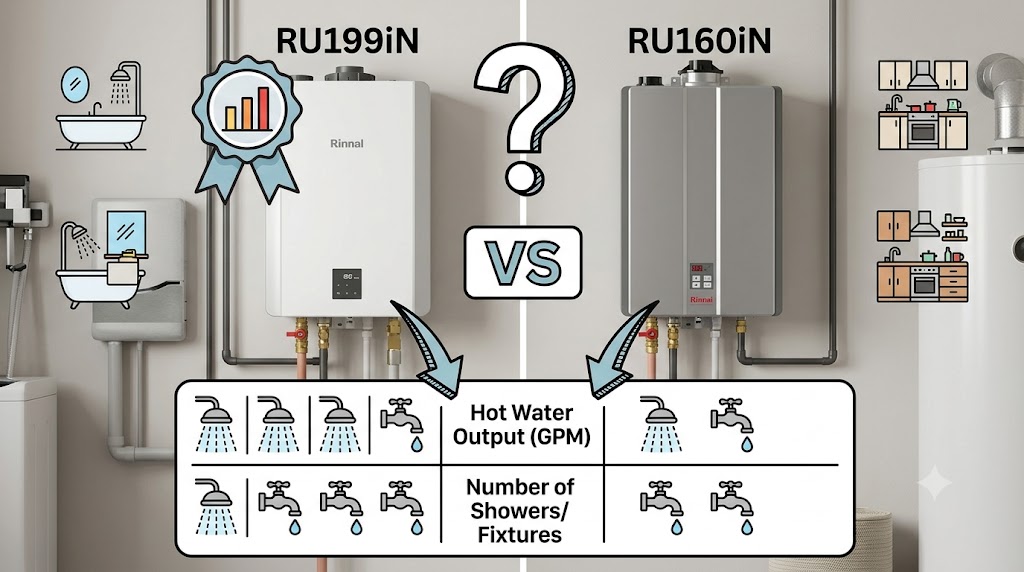
Both the RU199iN and RU160iN are now part of Rinnai’s discontinued lineup, but the sizing logic that separated them still matters enormously if you’re trying to figure out the right replacement capacity for your household today. Understanding the gap between these two historical models is the fastest way to correctly size their current Smart Sense equivalents.
The Rinnai RU199iN (199,000 BTU, up to 11 GPM) and RU160iN (160,000 BTU, up to 6.6 GPM based on Rinnai’s REP160iP successor specs) served different household sizes, with the RU199iN built for larger homes or higher simultaneous demand, and the RU160iN suited to smaller to mid-sized households with more modest hot water needs. Both models are discontinued, but Rinnai’s current Smart Sense lineup preserves this same two-tier sizing logic through updated model numbers.
Side-by-Side Comparison
| Spec | RU160iN | RU199iN |
|---|---|---|
| BTU rating | 160,000 | 199,000 |
| Max flow rate | Up to 6.6 GPM | Up to 11 GPM |
| Typical household fit | Small to mid-sized, 1-2 bathrooms | Mid to large, 2-4 bathrooms |
| Status | Discontinued | Discontinued (September 2024) |
Why BTU Rating Drives Household Fit
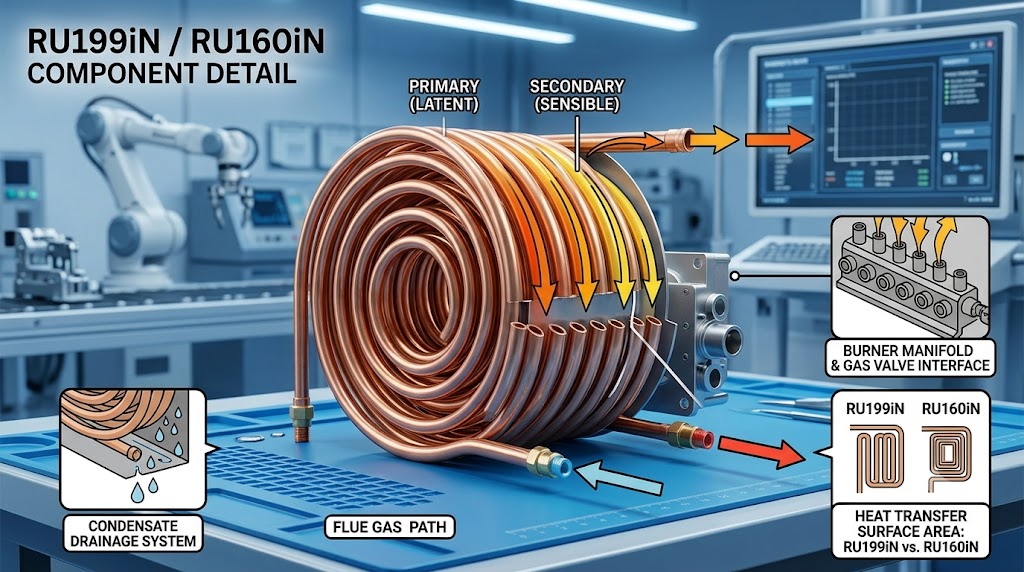
The BTU (British Thermal Unit) rating measures how much heating power a tankless unit can apply to raise incoming water to your desired temperature. A higher BTU rating supports either a higher flow rate at the same temperature rise, or the same flow rate at a bigger temperature rise (relevant in colder climates with cold groundwater). This is why the RU199iN’s roughly 39,000 additional BTU over the RU160iN translates into a meaningfully higher usable GPM ceiling, nearly 4.4 more gallons per minute at maximum output.
When the Smaller Unit Was Enough
For households with one or two bathrooms and modest simultaneous demand, rarely running more than a single shower alongside a sink or a load of laundry, the RU160iN’s 6.6 GPM ceiling was generally sufficient. Sizing correctly to a smaller unit when your household doesn’t need the extra capacity avoids paying for BTU output you’ll never use.
When You Needed the Larger RU199iN
Larger households, homes with 3 or more bathrooms, or households in colder climates needing a bigger temperature rise to reach comfortable output temperatures, generally benefited from the RU199iN’s higher BTU ceiling. The extra capacity provided headroom for multiple simultaneous fixtures without the temperature drops that an undersized unit would produce under heavy demand.
What This Means for Buying Today
Since both models are discontinued, this comparison is most useful as a sizing framework to apply to Rinnai’s current lineup. If your household previously would have been well-served by an RU160iN-class unit, look at Rinnai’s comparable current-generation smaller condensing models. If you needed RU199iN-class capacity, the RX199iN or RXP199iN (both rated up to 11.1 GPM at 199,000 BTU) are the direct current equivalents.
A Simple Sizing Check
Count your household’s realistic peak simultaneous hot water demand (showers, sinks, laundry, dishwasher running at the same time during your busiest period), and match that against each unit class’s rated GPM ceiling, accounting for your local groundwater temperature reducing usable flow in colder climates. If in doubt, sizing toward the larger capacity class provides a more comfortable buffer, particularly since electrical and gas line upgrades are more disruptive to redo later than to plan for upfront.
For the complete rundown of what today’s equivalent to the RU199iN offers, see our full RU199iN review and current replacement guide.
Rinnai RXP199iN Condensing Tankless Water Heater with Built-In Recirculation Pump - View on Amazon
The Bottom Line
The RU199iN’s extra BTU capacity over the RU160iN made it the better fit for larger households and colder climates needing more simultaneous hot water capacity. Both models are discontinued, but the same sizing logic applies directly to choosing between Rinnai’s current Smart Sense lineup today.
Frequently Asked Questions
What’s the difference between the RU160iN and RU199iN? The RU199iN offers a higher 199,000 BTU rating versus 160,000 BTU for the RU160iN, translating into a higher maximum flow rate (up to 11 GPM versus up to 6.6 GPM).
Are both the RU160iN and RU199iN discontinued? Yes, both are part of Rinnai’s older discontinued lineup, replaced by the company’s current Smart Sense condensing models.
Which unit is better for a large family? The RU199iN’s higher BTU and GPM capacity generally made it the better fit for larger households or homes with more bathrooms running simultaneous hot water demand.
Is a higher BTU rating always better? Not necessarily, sizing appropriately to your actual household demand avoids paying for capacity you don’t need. A correctly sized smaller unit is often the more cost-effective choice for modest households.
What replaced the RU160iN and RU199iN? Rinnai’s current Smart Sense lineup, including models like the RX199iN and RXP199iN in the RU199iN’s capacity class, continues the same general sizing tiers under updated model numbers.
How do I know which size tankless heater I need? Count your household’s peak simultaneous hot water demand across all fixtures likely to run at once, and match that against a unit’s rated GPM capacity, accounting for your local groundwater temperature.
Does climate affect which size unit I should choose? Yes, colder climates require a bigger temperature rise to reach comfortable output temperatures, which reduces usable flow rate, so cold climate households may need to size up compared to a warm climate household with the same fixture count.
Can I still buy either the RU160iN or RU199iN new? No, both are discontinued. Current buyers should look at Rinnai’s active Smart Sense lineup for comparable capacity options.
Is the current replacement for the RU199iN more expensive than the RU160iN’s replacement? Generally yes, higher-capacity units in any manufacturer’s current lineup typically cost more than smaller-capacity models, reflecting the additional components needed to support higher BTU output.
Should I size up if I’m unsure which capacity I need? Sizing up provides a comfortable buffer for unexpected demand or colder winters, and is generally easier to plan for upfront than needing to redo gas line or electrical work later if you undersize.
References
- Rinnai official product specifications for the RU199iN and related model lineup, accessed July 2026: https://www.rinnai.us
- Amazon.com and HVAC retailer listings for Rinnai’s current Smart Sense condensing lineup, accessed July 2026