
The gap between a 6.6 GPM unit and an 11.2 GPM unit sounds abstract until you’re standing in a cold shower because someone started the dishwasher. Getting this number right before you buy is the single most important decision in the entire purchase, more important than brand.
Correctly sizing a gas tankless water heater means matching your household’s peak simultaneous hot water demand in gallons per minute (GPM) against a unit’s rated flow capacity at your specific groundwater temperature, since flow rate figures like the Rinnai RXP199iN’s “up to 11.1 GPM” or the Navien NPE-240A2’s “up to 11.2 GPM” both assume a specific temperature rise that may not match your actual climate. Undersizing leads to temperature drops under simultaneous demand, while correctly sizing (or modestly oversizing) provides comfortable headroom.
Step One: Calculate Peak Simultaneous GPM Demand
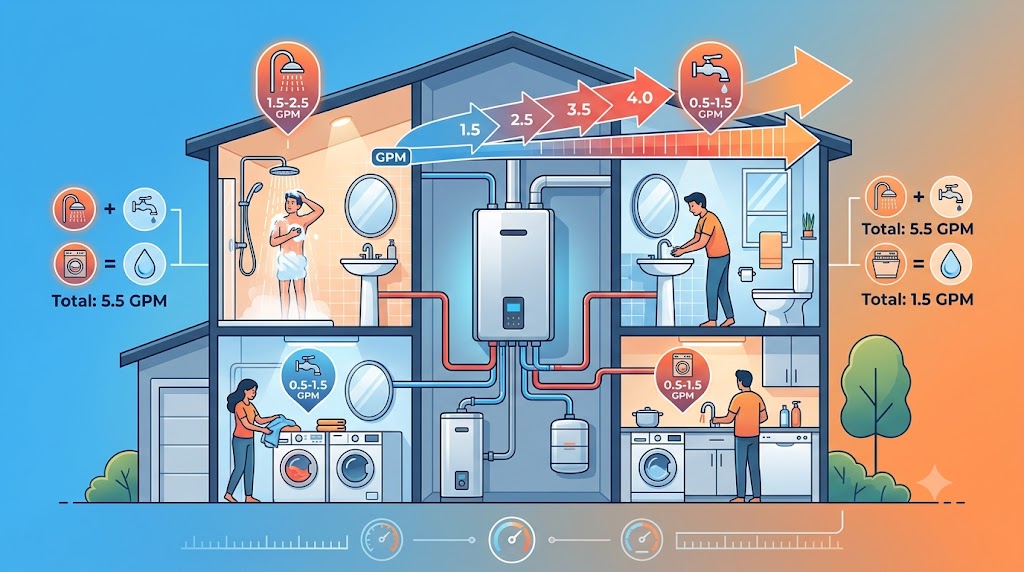
Add up the flow rate of every fixture likely to run at the same time during your household’s busiest period:
| Fixture | Typical GPM |
|---|---|
| Bathroom sink | 0.5 GPM |
| Kitchen sink | 1.0 to 2.0 GPM |
| Dishwasher | 1.0 to 2.0 GPM |
| Washing machine | 1.0 to 1.5 GPM |
| Standard shower head | 2.0 GPM |
| Water-saving shower head | 1.5 GPM |
| Bathtub | Up to 4.0 GPM |
A household running three showers simultaneously, roughly 6 GPM, is right in the range where a high-capacity unit like the RXP199iN or NPE-240A2 (both rated over 11 GPM at optimal conditions) becomes genuinely necessary rather than a luxury.
Step Two: Understand the Temperature Rise Asterisk
Every manufacturer’s headline GPM figure assumes a specific incoming water temperature and a specific temperature rise to reach your desired output. Navien’s own spec sheet for the NPE-240A2 specifically notes “MAX GPM (67°F Rise)” as the basis for its 11.2 GPM figure, meaning that’s the flow rate achievable when raising water temperature by 67 degrees Fahrenheit, a real, specific condition, not a universal guarantee.
If your climate requires a bigger temperature rise (colder groundwater, or a higher desired output temperature), your usable flow rate at maximum capacity will be lower than the advertised headline figure. This is true across every brand in this category, not unique to any single manufacturer.
Step Three: Match to Household Size
As a general reference point based on manufacturer capacity classes:
Smaller households (1-2 bathrooms, moderate simultaneous demand) can often be well served by mid-capacity units in the 130,000 to 160,000 BTU range.
Mid to large households (2-4 bathrooms, regular overlapping fixture use) generally benefit from the higher-capacity 199,000 BTU class covered throughout this guide, including the Rinnai RXP199iN and Navien NPE-240A2.
Larger households or homes in cold climates with significant simultaneous demand may need to consider even higher-capacity commercial-adjacent units, or splitting demand across multiple units serving different zones.
Common Sizing Mistakes
The most common and costly mistake is sizing based purely on the manufacturer’s headline GPM figure without accounting for your specific climate’s temperature rise requirement. A household in a cold northern climate sizing based on a unit’s warm-climate 11+ GPM rating may find their actual usable flow meaningfully lower once winter groundwater temperatures kick in.
The second common mistake is underestimating realistic simultaneous demand by only considering “normal” usage rather than genuine peak moments, like multiple people showering before work or school while a dishwasher runs.
A Practical Approach
Calculate your realistic peak GPM demand using the fixture chart above, then check the specific manufacturer’s GPM rating at a temperature rise that matches your actual regional groundwater conditions, not just the best-case headline number. When in doubt, sizing toward the higher end of the 199,000 BTU class (like the RXP199iN or NPE-240A2) provides meaningful headroom for both simultaneous demand and colder-than-expected conditions.
For the complete comparison of today’s top units in this exact capacity class, see our best condensing tankless water heater guide.
Rinnai RXP199iN Condensing Tankless Water Heater with Built-In Recirculation Pump - View on Amazon
The Bottom Line
Correctly sizing a tankless water heater means matching your household’s real peak simultaneous demand against a unit’s rated flow capacity at your specific climate’s temperature rise, not just the manufacturer’s best-case headline GPM figure. When uncertain, sizing toward the higher-capacity 199,000 BTU class provides useful headroom.
Frequently Asked Questions
How do I size a gas tankless water heater? Calculate your household’s peak simultaneous GPM demand across all fixtures likely to run at once, then match that against a unit’s rated flow capacity at a temperature rise matching your actual climate conditions.
What does “GPM at 67°F rise” mean? It’s the flow rate a unit can achieve while raising incoming water temperature by 67 degrees Fahrenheit, a specific reference condition used by manufacturers like Navien, not a universal guarantee across all climates.
How many GPM do I need for a 3 bathroom house? This depends on realistic simultaneous usage, but a household regularly running 2-3 fixtures at once typically needs a unit in the 8 to 11+ GPM range to comfortably avoid temperature drops.
Does climate affect tankless water heater sizing? Yes significantly. Colder incoming groundwater requires a bigger temperature rise to reach your desired output temperature, which reduces the unit’s usable flow rate compared to its warm-climate rating.
What happens if I undersize my tankless water heater? You’ll experience temperature drops or reduced flow when multiple fixtures run simultaneously, particularly during colder months when groundwater temperature is lower.
Is it better to oversize a tankless water heater? Moderate oversizing provides useful headroom for unexpected simultaneous demand and colder conditions, though significant oversizing adds cost without proportional benefit for most households.
Are the Rinnai RXP199iN and Navien NPE-240A2 similarly sized? Yes, both are rated in the same high-capacity class (199,000+ BTU, 11+ GPM), making them broadly interchangeable from a sizing perspective.
How do manufacturers determine their GPM ratings? Manufacturers typically test and publish GPM ratings at a specific temperature rise condition, which should be checked against your actual regional groundwater temperature for accurate sizing.
Should I consult a professional for sizing? For anything beyond a simple single-bathroom replacement, a licensed plumber can perform a proper load calculation accounting for your specific home’s fixture count and regional climate conditions.
Can one tankless unit serve a large home with multiple bathrooms? Yes, provided it’s correctly sized for your household’s realistic peak simultaneous demand and climate. High-capacity units like the RXP199iN and NPE-240A2 are specifically built for this larger household use case.
References
- Navien official product specifications for the NPE-240A2, including GPM rating methodology, accessed July 2026: https://www.navieninc.com
- Rinnai official product specifications for the RXP199iN, accessed July 2026