
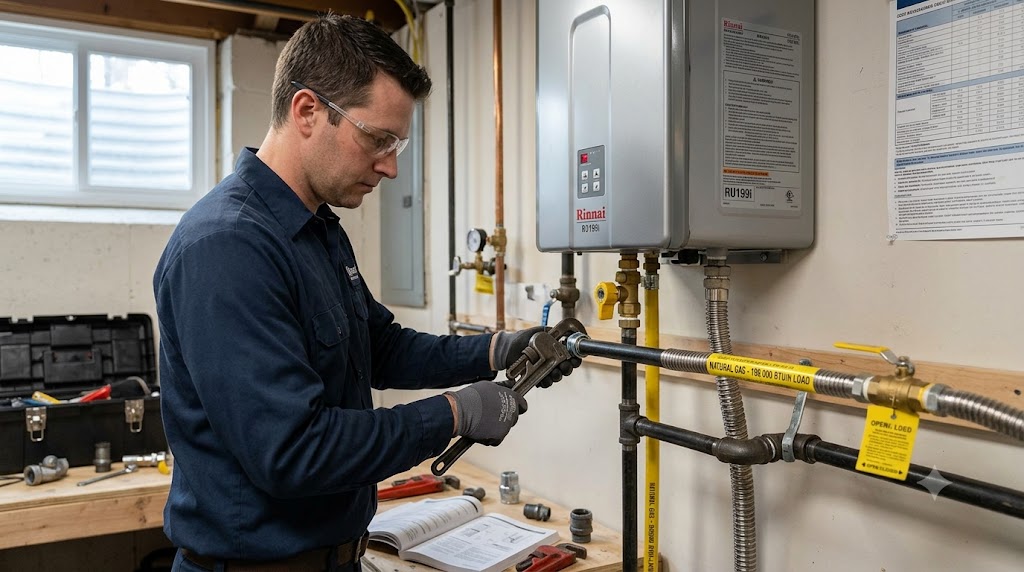
A plumber shows up to install your new tankless water heater and delivers unwelcome news: your existing gas line is too small to feed a 199,000 BTU unit properly. This is one of the most common surprises homeowners run into when upgrading from a standard tank heater, and it’s worth understanding before you schedule installation.
Rinnai’s 199,000 BTU units, including the RXP199iN and RX199iN, generally require a 3/4 inch gas line at minimum, though exact sizing depends on your home’s total gas demand, pipe length, and local code requirements, and should always be confirmed by a licensed professional using the manufacturer’s official sizing chart. Undersized gas lines cause pressure drop that prevents these high-BTU units from firing at full capacity.
Why Gas Line Size Matters So Much
Standard tank water heaters typically run on 30,000 to 40,000 BTUs. Rinnai’s high-capacity condensing tankless units run at 199,000 BTUs, roughly five times the demand. That jump means your existing gas line, sized for a much smaller appliance, may not deliver enough gas volume to let the tankless unit perform at its rated output.
This isn’t a minor inconvenience. An undersized gas line can cause the unit to underperform, trigger error codes, or fail to reach set temperature during high-demand periods, exactly the situations a tankless heater is supposed to handle well.
Factors That Affect Proper Gas Line Sizing
Total BTU demand across your entire home matters, not just the water heater. If you have a gas furnace, range, or fireplace sharing the same gas line, the sizing calculation needs to account for all of them running simultaneously.
Pipe length between your gas meter and the water heater location affects sizing too. Longer runs generally require larger diameter pipe to maintain adequate pressure at the appliance.
Local plumbing and gas codes vary by jurisdiction, and your installer needs to size the line according to codes applicable in your specific area, not just manufacturer minimums.
What a Proper Gas Line Assessment Looks Like
A qualified installer calculates total BTU demand for every gas appliance on the line, measures the distance from meter to appliance, and cross-references that against a standard gas pipe sizing chart (commonly based on NFPA 54, the National Fuel Gas Code) to determine minimum pipe diameter for adequate delivery.
This is not something to guess at or skip. Get this assessment done by a licensed professional as part of your installation quote, before assuming your existing line will work.
Common Gas Line Upgrade Scenarios
Homes replacing a standard tank heater with a first-time tankless installation often need a dedicated larger gas line run from the meter or an upsized branch line, since tank heaters simply don’t demand the same BTU volume.
Homes already running a smaller-capacity tankless unit and upgrading to a 199,000 BTU model may also need a line upgrade, since not all tankless units share the same gas demand.
How This Affects Your Installation Cost
Gas line upgrades add real cost to a tankless installation, and this is one of the most common reasons installation quotes vary so widely between homes. A short run needing modest upsizing costs far less than a full re-run from the meter through finished walls. For a fuller picture of what installation actually costs, see our installation cost breakdown.
Rinnai RXP199iN Condensing Tankless Water Heater with Built-In Recirculation Pump - View on Amazon
The Bottom Line
Rinnai’s 199,000 BTU units demand significantly more gas volume than a standard tank heater, and undersized gas lines are one of the most common installation snags homeowners encounter. Have a licensed professional assess your total gas demand, pipe length, and local code requirements before installation, rather than assuming your current line will work.
Frequently Asked Questions
What size gas line does a Rinnai 199,000 BTU tankless heater need? Generally a 3/4 inch line at minimum, though exact sizing depends on total home gas demand, pipe length, and local code, and should be confirmed by a licensed professional.
Can I use my existing gas line from a tank water heater? Often not without modification, since tank heaters typically run on far fewer BTUs than a 199,000 BTU tankless unit, and the existing line may be undersized for the new demand.
What happens if my gas line is too small? An undersized line can cause pressure drop, preventing the unit from firing at full capacity, which may lead to underperformance or error codes during high-demand periods.
Who determines the correct gas line size for my installation? A licensed plumber or installer should calculate total BTU demand across all gas appliances and cross-reference pipe length against a standard sizing chart, commonly based on NFPA 54.
Does gas line upgrade work add much to installation cost? It can, and it’s one of the main reasons installation quotes vary between homes, a short upsizing run costs far less than a full re-run through finished walls.
Do other gas appliances in my home affect gas line sizing? Yes, total BTU demand across every appliance sharing the line, including furnaces, ranges, or fireplaces, factors into proper sizing calculations.
Is gas line sizing based on national code or local code? Both, national standards like NFPA 54 provide baseline guidance, but your installer must also follow your specific local jurisdiction’s plumbing and gas codes.
Can I size my own gas line without a professional assessment? This isn’t recommended, given the safety implications of gas line work and the technical calculations involved in matching pipe size to total demand and run length.
Does pipe length affect gas line sizing? Yes, longer runs between the gas meter and the appliance generally require larger diameter pipe to maintain adequate pressure.
Should I get a gas line assessment before getting an installation quote? Yes, this should be part of any complete installation quote, so you understand the full project scope before committing to an installer.
References
- NFPA 54, National Fuel Gas Code, referenced industry standard for gas pipe sizing, accessed July 2026: https://www.nfpa.org/codes-and-standards/nfpa-54-standard-development/54
- Rinnai official installation and specification guidance for the RXP199iN, accessed July 2026: https://www.rinnai.us