
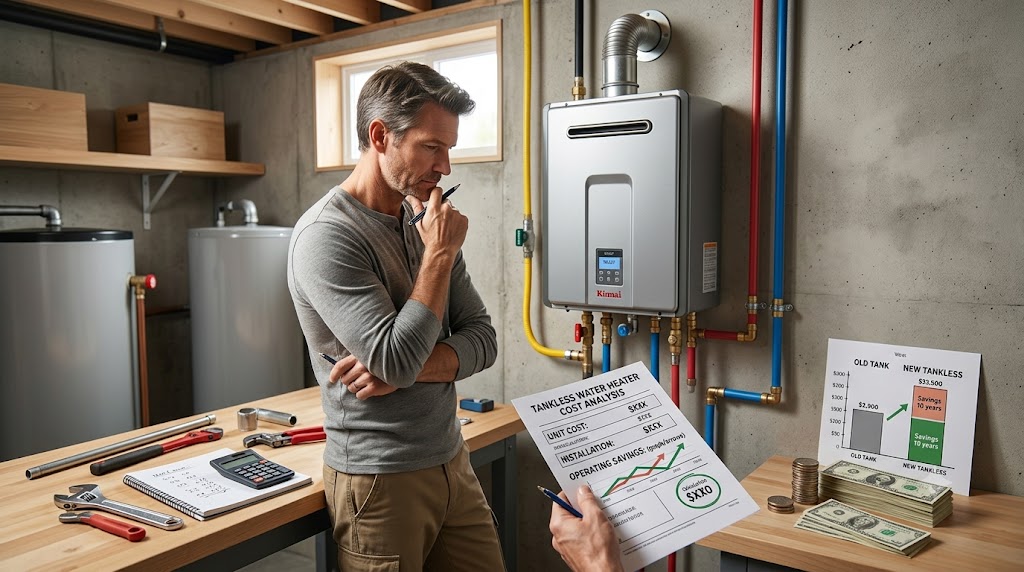
A Facebook post found during research on Navien installation costs quoted a plumbing company’s standard install starting at $4,200, discounted to $4,000 or $3,900 during a promotional period. That’s a substantial number, and it’s exactly the kind of real installed cost that needs to sit alongside the efficiency marketing before you can honestly answer whether tankless makes sense for your household.
A high-capacity condensing tankless water heater like the Rinnai RXP199iN or Navien NPE-240A2 costs roughly $1,700 to $2,200 for the unit alone, with total installed cost, including gas line work, venting, and labor, commonly running $3,900 to $4,200 or more based on real contractor quotes found during research. Whether that’s worth it depends heavily on your household’s hot water usage, your local gas rates, and how long you plan to stay in your home to recoup the higher upfront cost compared to a traditional tank system.
The Real Installed Cost Picture
Unit price alone doesn’t reflect what most households actually pay. A real Facebook post from a plumbing company advertising Navien NPE-240A2 installation specifically listed a standard installation cost “starting at $4,200.00” with a promotional discount bringing it to “$4,000.00 out the door” or “$3,900.00” depending on timing. This total figure includes the unit itself, labor, and typically venting and gas line work specific to condensing tankless installation requirements.
This is a meaningfully larger number than many buyers expect when they first see a $1,700 to $2,200 unit price advertised online, and it’s worth budgeting for the full installed cost, not just the equipment price, when deciding if tankless is worth it for your situation.
Where the Extra Installation Cost Comes From
Condensing tankless units require PVC venting (due to their lower exhaust gas temperature compared to non-condensing units) and often need gas line upsizing to support their higher BTU demand, both of which add labor and material costs beyond what a simple tank replacement would require. If you’re replacing an existing tankless unit, some of this infrastructure may already be in place, reducing your total installation cost meaningfully compared to a first-time tankless conversion from a traditional tank system.
The Efficiency Case for Tankless
Condensing tankless units achieve genuinely high efficiency ratings, commonly in the 0.95 to 0.96 range for UEF or Energy Factor, compared to significantly lower ratings typical of standard tank water heaters. This efficiency advantage comes from two sources: eliminating standby heat loss (tankless units only heat water on demand, rather than maintaining a full tank at temperature continuously) and condensing technology’s ability to extract additional heat from exhaust gases before venting.
Over the unit’s operating lifespan, this efficiency advantage translates into real energy savings, though the exact dollar amount depends heavily on your household’s actual hot water usage volume and your local natural gas rates.
When Tankless Makes the Most Financial Sense
Tankless systems make the strongest financial case for households with substantial, consistent hot water demand, larger families, homes with multiple bathrooms in regular simultaneous use, where the efficiency gains compound meaningfully over years of heavy usage. Households planning to stay in their home long term also see a better return on the higher upfront installation cost, since the investment has more time to pay off through ongoing energy savings.
When a Tank System Might Make More Sense
For smaller households with modest, infrequent hot water demand, or for homeowners planning to sell or move within a few years, the higher upfront installed cost of tankless (potentially $3,900+ versus a simpler tank installation) may not have enough time or usage volume to fully offset through energy savings before you move on from the property.
Making the Decision
Weigh your household’s realistic hot water usage pattern, how long you plan to stay in your home, and your local gas rates against the real installed cost figures covered here, not just the unit price you see advertised. For many households with genuine, consistent hot water demand, the long-term efficiency case for tankless holds up. For smaller or more transient households, the math is less clear-cut.
For the complete technical comparison of today’s top options in this category, see our best condensing tankless water heater roundup.
Rinnai RXP199iN Condensing Tankless Water Heater with Built-In Recirculation Pump - View on Amazon
The Bottom Line
A condensing tankless water heater is worth it for households with substantial, consistent hot water demand and long-term homeownership plans, where the efficiency gains have time to offset the real installed cost, commonly $3,900 or more based on actual contractor quotes. Smaller households or shorter-term homeowners should weigh that upfront cost more carefully against their specific usage patterns.
Frequently Asked Questions
Is a tankless water heater worth the extra cost? For households with substantial, consistent hot water demand and long-term homeownership plans, generally yes. For smaller households or those planning to move soon, the higher upfront installed cost may not fully pay off in time.
How much does it really cost to install a condensing tankless water heater? Based on a real contractor quote found during research, standard installation for a unit like the Navien NPE-240A2 starts around $4,200, with promotional pricing sometimes bringing it to $3,900 to $4,000.
Why is tankless installation more expensive than a tank system? Condensing tankless units require PVC venting and often gas line upsizing to support higher BTU demand, both adding labor and material costs beyond a simpler tank replacement.
Do tankless water heaters really save money long term? Yes, through eliminating standby heat loss and condensing technology’s higher efficiency, though the exact savings depend on your household’s usage volume and local gas rates.
How long does it take for a tankless water heater to pay for itself? This varies significantly by household usage and local energy costs, generally favoring larger households with consistent hot water demand and longer homeownership timelines.
Is tankless worth it for a small household? The financial case is less clear-cut for smaller households with modest hot water demand, since the efficiency gains have less usage volume to compound against the higher installed cost.
What’s included in a typical tankless installation cost? Based on real contractor quotes, this typically includes the unit, labor, venting work, and often gas line modifications needed to support the unit’s BTU demand.
Does replacing an existing tankless unit cost less than converting from a tank? Often yes, since venting and gas line infrastructure may already be in place from the previous tankless installation, reducing the additional work needed.
What efficiency rating should I look for in a tankless water heater? UEF or Energy Factor ratings in the 0.90s indicate strong condensing efficiency, meaningfully higher than the ratings typical of standard tank water heaters.
Should I get multiple quotes before installing a tankless water heater? Yes, given the significant cost variation possible (as seen in the promotional pricing example referenced here), getting multiple contractor quotes helps ensure you’re paying a fair price for your specific installation.
References
- Facebook community post from a plumbing company advertising real Navien NPE-240A2 installation pricing, accessed July 2026
- Navien and Rinnai official specifications for condensing tankless efficiency ratings, accessed July 2026