
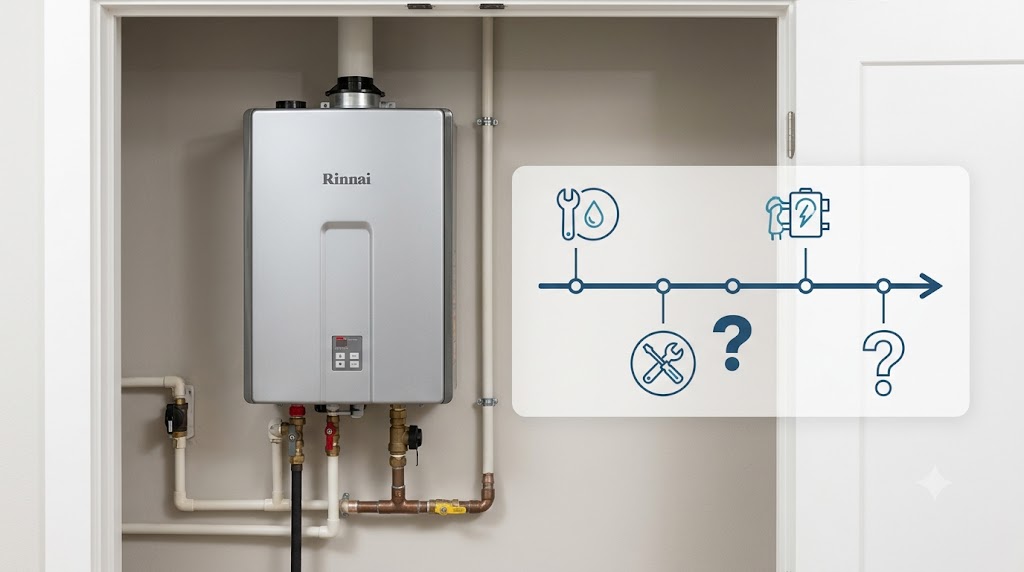
Anyone comparing the upfront cost of a tankless water heater against a traditional tank unit eventually asks the practical follow-up question: how many years of service am I actually buying with this investment? The answer plays a real role in whether the higher upfront cost makes financial sense over time.
Rinnai tankless water heaters, including the RXP199iN and RX199iN, are generally expected to last 20 years or more with proper maintenance, meaningfully longer than the typical 10 to 15 year lifespan of a standard tank water heater. Actual lifespan depends heavily on water quality, maintenance consistency, and installation quality.
Why Tankless Units Tend to Outlast Tank Heaters
Tankless units don’t store standing water, which eliminates the tank corrosion and sediment buildup that typically limits a traditional tank heater’s lifespan. Instead, the primary wear factor for tankless units is mineral scale accumulation on the heat exchanger, a condition that’s directly manageable through regular descaling maintenance.
This fundamental difference in failure mode is a major reason tankless units can meaningfully outlast tank heaters when properly maintained.
The Biggest Factor: Water Quality and Maintenance
Homes with hard water that skip regular descaling maintenance will see meaningfully reduced lifespan compared to homes that either have softer water or stay consistent with annual descaling. This single factor arguably has more influence on real-world lifespan than any other variable, since scale buildup is the primary mechanism behind tankless heat exchanger wear over time.
See our [maintenance schedule guide] and [descaling how-to guide] for the specific steps that protect long-term lifespan.
Installation Quality Matters Too
Proper gas line sizing, correct venting installation, and appropriate water pressure at installation all contribute to a unit operating within its designed parameters over its lifespan, rather than under stress conditions that could accelerate wear on components.
What Actually Fails First
When tankless units do eventually need replacement, it’s often specific components like the heat exchanger, ignition system, or control board reaching end of service life, rather than the kind of catastrophic tank failure and flooding risk associated with an aging traditional tank water heater.
Does the Warranty Length Reflect Expected Lifespan?
Rinnai’s warranty terms (which vary by component and should be confirmed directly with Rinnai or your retailer for your specific model) provide one signal of expected reliability, though actual service life for well-maintained units often extends well beyond the warranty period itself, similar to how many appliances outlast their warranty coverage when properly cared for.
Getting the Most Years Out of Your Investment
Stay consistent with annual descaling, especially in hard water areas, ensure your installation was done correctly by a qualified professional, and address any error codes or performance issues promptly rather than letting problems compound over time. These simple habits are the biggest lever homeowners have over their unit’s real-world lifespan.
Rinnai RXP199iN Condensing Tankless Water Heater with Built-In Recirculation Pump - View on Amazon
The Bottom Line
Rinnai tankless water heaters are generally expected to last 20 years or more with proper maintenance, notably longer than a typical tank heater’s 10 to 15 year lifespan. Water quality and consistent descaling maintenance are the biggest factors determining whether you reach or exceed that expected lifespan.
Frequently Asked Questions
How long do Rinnai tankless water heaters typically last? Generally 20 years or more with proper maintenance, notably longer than the typical 10 to 15 year lifespan of a standard tank water heater.
What’s the biggest factor affecting tankless water heater lifespan? Water quality and maintenance consistency, particularly regular descaling, has more influence on real-world lifespan than almost any other single factor.
Do tankless water heaters last longer than tank heaters? Yes, generally, since they don’t store standing water and avoid the tank corrosion and sediment buildup that limits traditional tank heater lifespan.
Does skipping maintenance shorten a tankless unit’s lifespan? Yes, meaningfully, mineral scale buildup on the heat exchanger from skipped descaling is the primary wear mechanism affecting tankless unit longevity.
What typically fails first on an aging tankless water heater? Specific components like the heat exchanger, ignition system, or control board, rather than a catastrophic tank failure like with traditional water heaters.
Does installation quality affect how long a unit lasts? Yes, proper gas line sizing, venting, and water pressure at installation help the unit operate within its designed parameters rather than under stress.
Is Rinnai’s warranty length the same as expected lifespan? No, warranty length is one reliability signal, but well-maintained units often provide service life well beyond their warranty coverage period.
Does hard water shorten a tankless water heater’s lifespan? Yes, hard water accelerates mineral scale buildup, which is why homes with hard water especially benefit from consistent, possibly more frequent, descaling.
Can I extend my unit’s lifespan beyond the typical expectation? Yes, consistent annual descaling, addressing issues promptly, and proper initial installation all support reaching or exceeding typical expected lifespan.
Is the higher upfront cost of a tankless unit worth it given its lifespan? This depends on your specific circumstances, but the meaningfully longer lifespan compared to tank heaters is a genuine factor in the long-term value calculation.
References
- Rinnai official product and warranty documentation, accessed July 2026: https://www.rinnai.us
- Rinnai official product specifications for the RXP199iN, accessed July 2026: https://www.amazon.com/s?k=Rinnai+RXP199iN